Adaptive and Efficient Robot Positioning Through Model and Task Fusion
Where are you? This is a fundamental question to which most of us usually know the answer, and so must the robots and augmented-reality devices of the future.
About the Fellowship
This project aims to create fit-for-purpose positioning systems that continuously adapt to diverse and changing environments. The project expects to contribute to the knowledge across robotics, computer vision and neuromorphic computing. Expected outcomes include ground-breaking place recognition techniques that address two fundamental limitations in the state of the art: continuous adaptation, critically important in safety-critical systems, and energy efficiency, critically important in resource-constrained systems.
Why it matters
When robots localise visually, the problem is often called visual place recognition (VPR). Crucially, VPR enables navigation and decision-making without risky dependence on satellites, which are unavailable indoors, unreliable in built-up areas, and over which Australia has no control. The Fellowship addresses three shortcomings of current VPR systems:
- Current VPR systems are “one size fits all”. They do not adapt well to changing environments, like transitioning from rural to urban areas.
- VPR algorithms do not exploit complementary information from non-positioning tasks that operate in parallel, like object detection and semantic segmentation.
- There is a heavy focus on conventional computing, raising questions about long-term sustainability, data privacy and ever-increasing power consumption. Neuromorphic computing provides a viable alternative for low-power edge devices.
This should provide significant benefits, such as accelerated deployment of mobile robots, drones and augmented reality solutions in manufacturing, defence, healthcare, households and space.
Research programs
How the project is organised.
Heterogeneity, adaptability and federation
Training schemes that maximise the diversity of heterogeneous models at training time, so that they perform optimally on different challenges. Intelligent fusion will enable adaptation to ever-changing environments.
It’s not all about positioning
Leveraging synergies between visual place recognition and non-positioning tasks like object detection and semantic segmentation. Places are composed of objects, so learning these tasks together is meaningful.
Neuromorphic place recognition
A fully neuromorphic place recognition pipeline: adaptive, low-latency systems using highly parallel algorithms that conventional hardware cannot host.
Team
Members of my group at the QUT Centre for Robotics and close collaborators.

Lead
 Michael Milford
Collaborator

Postdoc

PhD student

PhD student

PhD student
More projects
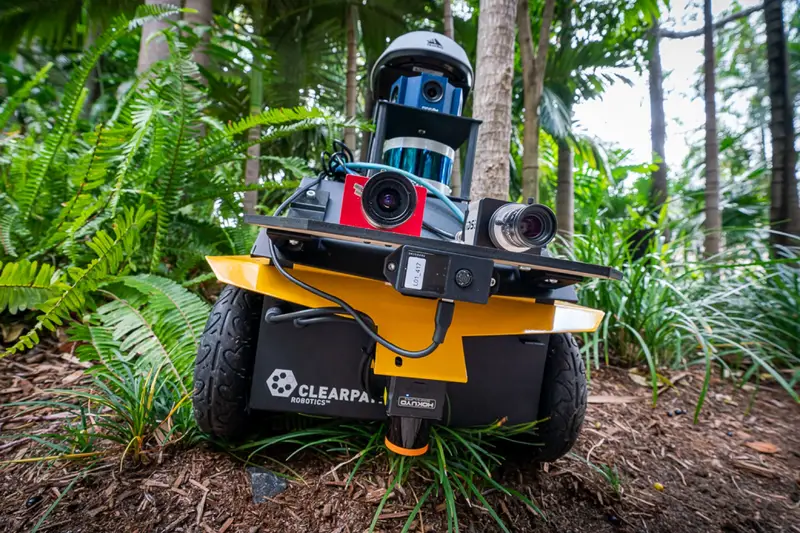
Brain-Inspired Positioning for Fast, Energy-Efficient, Resilient Robotics
The world’s first sub-millisecond, energy-efficient robot positioning system, using brain-inspired sensing and computation that only happens when the scene changes.
Learn More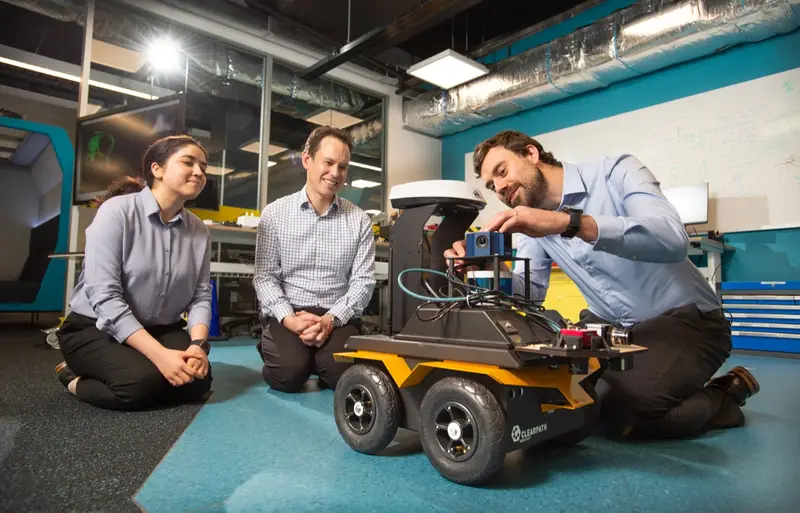
Neuromorphic Place Recognition
Spiking neural networks that recognise places on neuromorphic hardware, using a fraction of the usual energy.
Learn More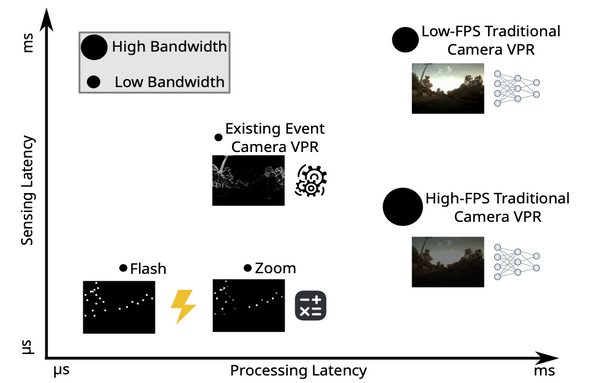
Event Cameras for Fast Localisation
Sensors that report only what changes, for sub-millisecond localisation in difficult lighting.
Learn More