Visual Localisation and 3D Mapping
Beyond recognising a place, robots need their precise position and orientation, and maps that remain usable as the world changes.
Why it matters
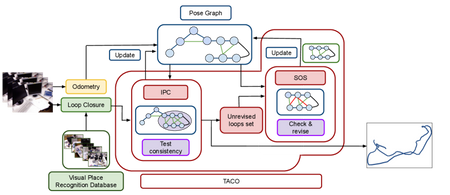
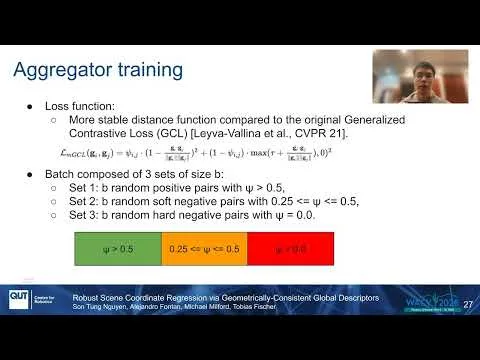
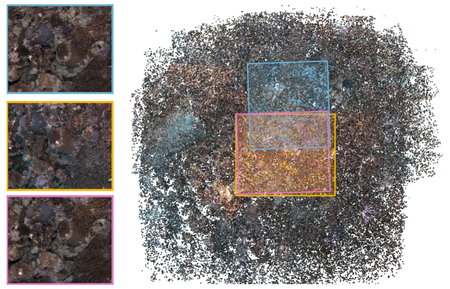
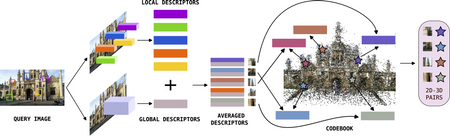
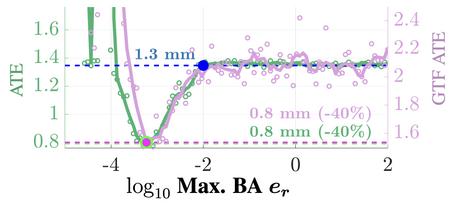
We work on scene coordinate regression and 2D–3D matching for accurate 6-DoF localisation, on making pose-graph optimisation robust to wrong loop closures, and on reconstructing the same place across many sessions despite substantial appearance change. We also showed that structure-from-motion and visual SLAM pipelines can be tuned without any ground truth.
Team
Members of my group at the QUT Centre for Robotics and close collaborators.

Lead
 Michael Milford
Collaborator

Former PhD student

Former postdoc

PhD student
 Alejandro Fontan
Collaborator

Former PhD student
More projects
Brain-Inspired Positioning for Fast, Energy-Efficient, Resilient Robotics
The world’s first sub-millisecond, energy-efficient robot positioning system, using brain-inspired sensing and computation that only happens when the scene changes.
Learn More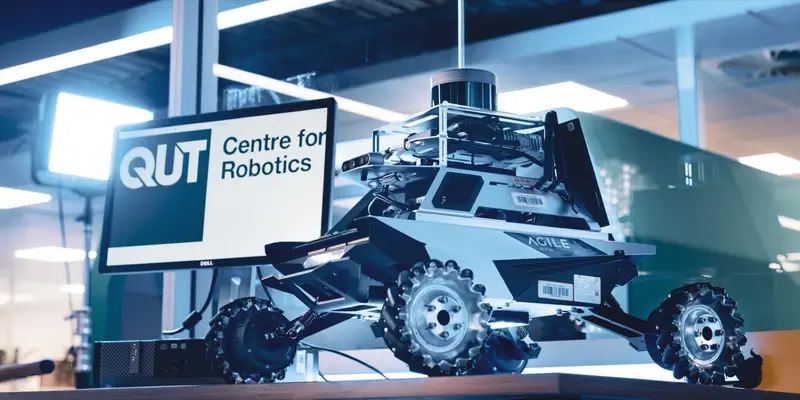
Adaptive and Efficient Robot Positioning Through Model and Task Fusion
Fit-for-purpose positioning systems that continuously adapt to diverse and changing environments, and are energy efficient enough for edge devices.
Learn More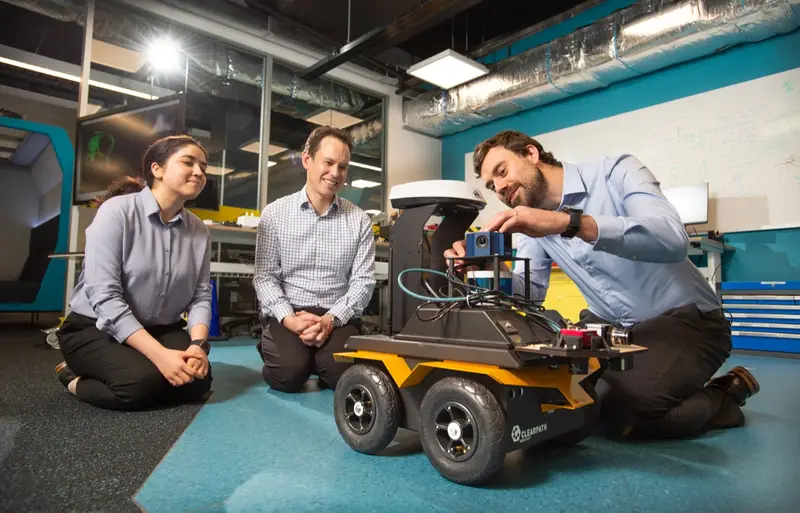
Neuromorphic Place Recognition
Spiking neural networks that recognise places on neuromorphic hardware, using a fraction of the usual energy.
Learn More