Robust Visual Place Recognition
Visual place recognition answers a robot's most basic question: have I been here before? We make it robust to appearance change and, just as importantly, able to predict its own reliability.
Why it matters
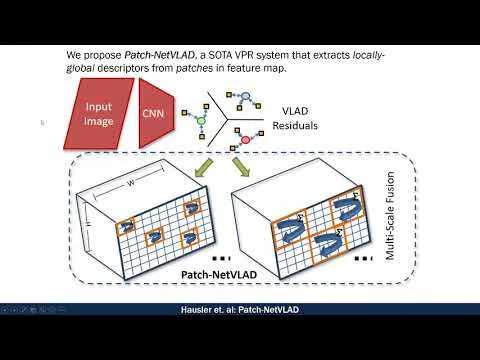
Place recognition is the backbone of loop closure in SLAM, of re-localisation after a robot gets lost, and of large-scale visual search. Patch-NetVLAD (CVPR 2021) showed how multi-scale local and global descriptors can be fused. Our IJCAI survey and IEEE Robotics and Automation Magazine tutorial helped define the field.
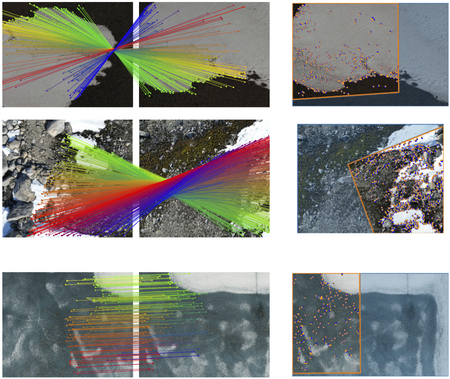
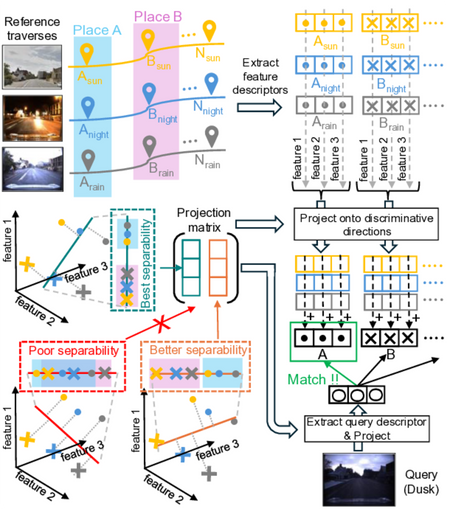
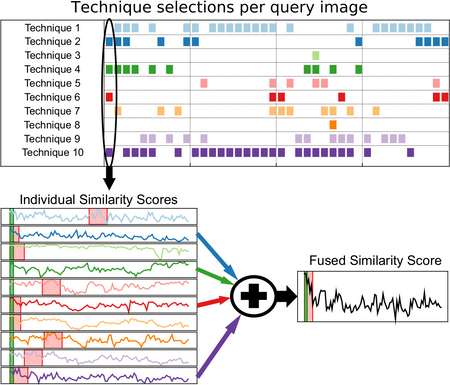
With an Amazon Research Award on Complementarity-Aware Multi-Process Fusion for Long Term Localization, we developed a hierarchical fusion framework that characterises where each localisation technique works well and fails, so that cheaper and more lightweight sensing and compute can still deliver long-term, privacy-preserving localisation for consumer robots. More recent work stacks descriptors into hyperdimensional place signatures, learns discriminative projections for multi-reference maps, and extends place recognition to LiDAR, aerial imagery in Antarctica, and comparisons with natural systems. How a system can tell when to trust its own answer is the focus of our introspection work.
Team
Members of my group at the QUT Centre for Robotics and close collaborators.

Lead
 Michael Milford
Collaborator

Postdoc

Former PhD student

Former PhD student

PhD student

Former PhD student
 Alejandro Fontan
Collaborator
Collaborator
Collaborator



More projects
Brain-Inspired Positioning for Fast, Energy-Efficient, Resilient Robotics
The world’s first sub-millisecond, energy-efficient robot positioning system, using brain-inspired sensing and computation that only happens when the scene changes.
Learn More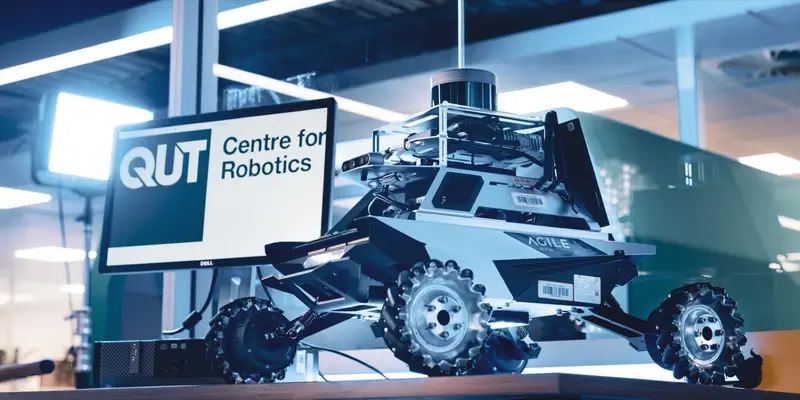
Adaptive and Efficient Robot Positioning Through Model and Task Fusion
Fit-for-purpose positioning systems that continuously adapt to diverse and changing environments, and are energy efficient enough for edge devices.
Learn More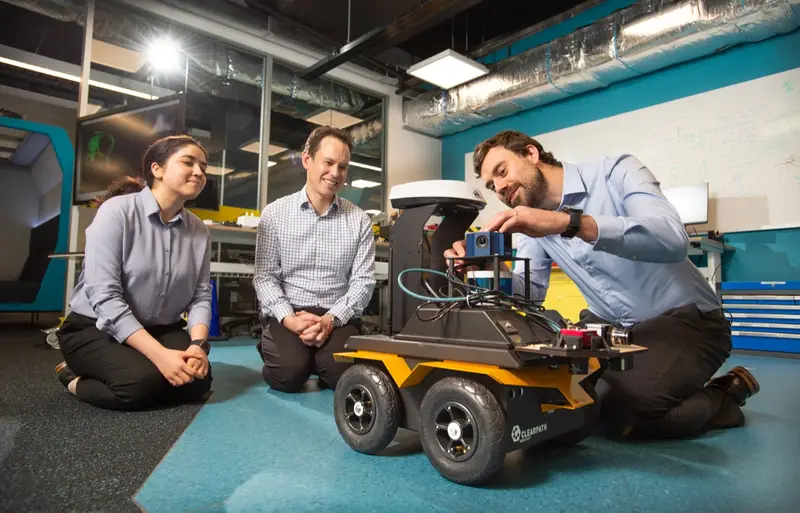
Neuromorphic Place Recognition
Spiking neural networks that recognise places on neuromorphic hardware, using a fraction of the usual energy.
Learn More